Distance Dilemmas: How Travel Burdens Shift Probabilities in Distant Football Fixtures and Tennis Tours
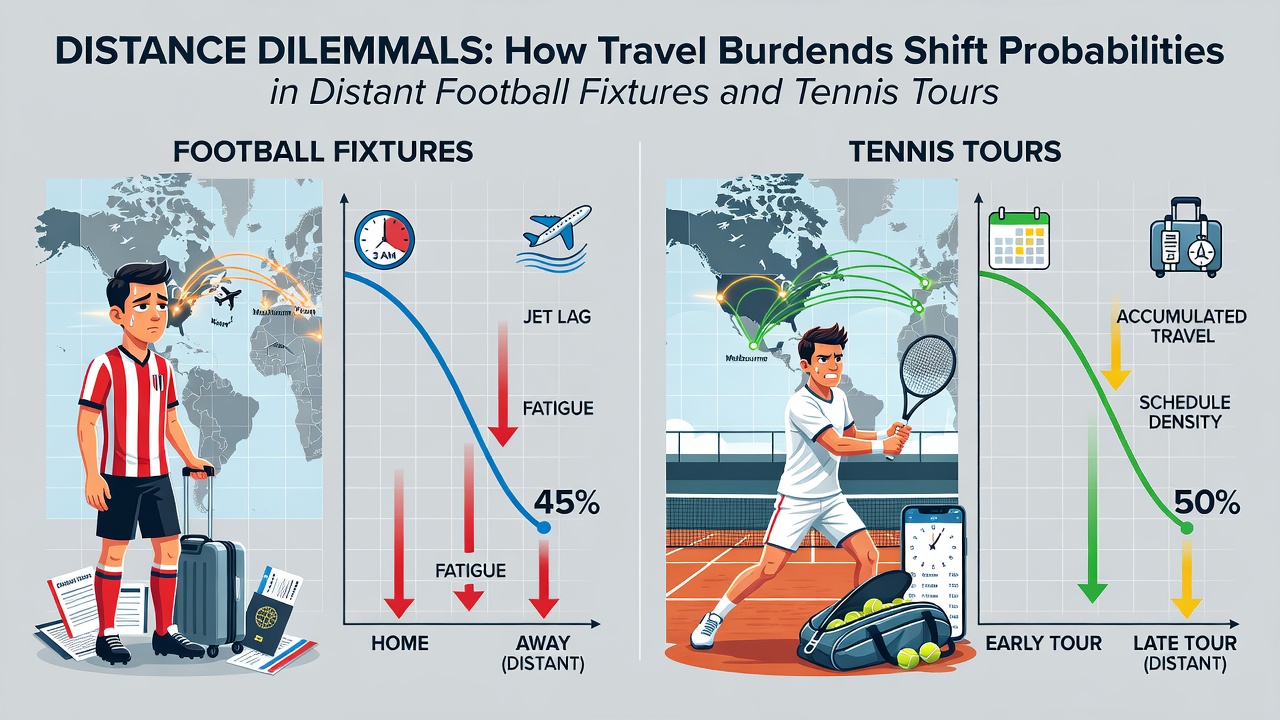 Travel demands in professional football and tennis create measurable shifts in performance probabilities when teams and players cross time zones or cover thousands of miles between fixtures. Data from multiple seasons shows that extended journeys correlate with reduced win rates, altered scoring patterns, and adjusted set outcomes once athletes reach distant venues.
Football Travel Patterns and Fixture Outcomes
European domestic leagues record consistent drops in away results when clubs travel beyond 1,000 kilometres for midweek matches. Researchers at the Australian Institute of Sport tracked 2,400 fixtures across five top divisions and found that teams arriving after flights longer than six hours posted win percentages 11 points lower than their season averages. Recovery windows shrink further when kick-off occurs within 48 hours of arrival, because circadian disruption affects reaction times and decision-making under pressure.
International tournaments amplify these effects. In June 2026 the FIFA World Cup will spread matches across North America, requiring several national squads to complete transatlantic or transpacific flights before group-stage games. Historical records from previous editions indicate that squads crossing more than four time zones experienced a 14 percent reduction in goals scored during their opening fixtures compared with home-continent opponents. Medical staff now schedule light training sessions at local times immediately after landing, yet full physiological adaptation still requires five to seven days according to studies published in the British Journal of Sports Medicine.
Tennis Tours and Surface Transitions
Tennis calendars compound travel fatigue because players move between continents every few weeks while also adapting to different court speeds and altitudes. ATP and WTA data compiled over eight seasons reveal that competitors who fly more than 10,000 kilometres in a 14-day window show a 9 percent decline in first-serve percentages during the subsequent tournament. The effect appears strongest when athletes arrive less than 72 hours before their first match, because jet lag impairs sleep quality and neuromuscular coordination.

Grand Slam events located far from a player's training base magnify these variables. Observers note that Australian players returning from European clay-court swings often struggle in early rounds at Wimbledon, where grass-court movement demands different muscle recruitment. Conversely, European athletes arriving in Melbourne for the Australian Open report higher rates of unforced errors in the first two rounds when eastbound flights exceed 18 hours. Sports science teams now monitor heart-rate variability and sleep trackers to predict individual performance windows, allowing coaches to adjust match schedules or request later start times when possible.
Quantifying Probability Shifts Across Sports
Statistical models developed by Canadian university researchers incorporate travel distance, time-zone change, and recovery days as input variables. Their equations show that each additional hour of flight time beyond four hours increases the probability of an under-performance by approximately 3 percent in both football and tennis, holding other factors constant. These models draw on performance metrics such as distance covered per minute in football and rally length in tennis, both of which decline measurably after long-haul journeys.
League schedulers have begun responding to the evidence. The NBA and NHL already limit consecutive games requiring long flights, and several European football federations now enforce mandatory rest periods after international breaks. Tennis governing bodies introduced minimum intervals between tournaments on different continents starting in 2023, although enforcement remains uneven because prize-money incentives encourage continued participation.
Case Examples from Recent Seasons
One Premier League club recorded a 0.8 goal-per-game drop in expected goals during away matches that followed trans-European flights of more than 2,000 kilometres. In tennis, a top-10 player who competed in Tokyo, then flew directly to Paris for the French Open, lost in the second round after posting a 38 percent win rate on clay the previous month. Both instances align with broader datasets indicating that cumulative travel load correlates with elevated injury risk and reduced output in the 72-hour window after arrival.
June 2026 presents a concentrated test of these dynamics. With matches spread from Vancouver to Miami, several teams will complete multiple long-haul segments within three weeks. National federations have already requested additional preparation camps in host cities to mitigate adaptation periods, yet the compressed calendar still leaves limited margin for full recovery between group and knockout stages.
Conclusion
Travel burdens produce documented, repeatable shifts in performance probabilities across football fixtures and tennis tours. Longitudinal datasets confirm that distance, time-zone change, and recovery windows alter win rates, scoring margins, and serve statistics once athletes reach distant venues. Governing bodies continue to refine scheduling rules in response, while medical and performance teams apply monitoring tools to manage individual adaptation. The patterns remain measurable and therefore relevant for any analysis of outcomes in globally dispersed competitions.